Celtic Myth & legend

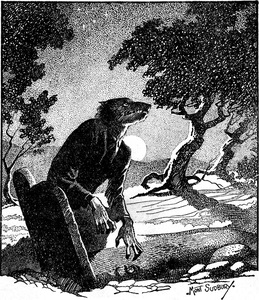
Wulver: Shetland's kind and generous werewolf

Werewolf

Shetland, also known as the Shetland Islands lie some 104 miles (168 km) northeast of Scotland. They form part of the division between the Atlantic Ocean to the west and the North Sea to the east. Humans have lived in Shetland since the Mesolithic period and there are over 5,000 archaeological sites all told. One such at West Voe on the south coast of Mainland, which is the largest island, has been dated to 4320–4030 BC.  During a period of Viking expansion, Shetland was eventually colonised by the Norse during the late 8th and 9th centuries. Norwegian king Harald Hårfagre annexed the Northern Isles (comprising Orkney and Shetland) in 875. Shetland remained under Norwegian influences until Shetland become part of Scotland in the 15th century.

Finfolk, the sinister creatures of the deep and the hidden islands of Orkney

Across the Celtic world there are myths and legends about strange creatures that emerge from the sea. Some are benign, many are malevolent and there are others who live a parallel existence with humankind, but whose paths rarely cross. Many of these entities live in hidden kingdoms and palaces under the seas. At times they are associated with islands that humans cannot see and the sunken cities that are said to exist beneath the waves off our Celtic coasts. One such island is the magical vanishing island of Hildaland in the seas around Orkney, the group of islands situated off the north coast of Scotland.

Nuckelavee - the malevolent creature that terrorised Scotland's Northern Isles

In the Celtic nations there are a number of mythological creatures that share the land and waters with humankind. Some are benign, others avoid their human neighbours at all costs. Probably they are the most sensible of all, because of the creatures of the world humans appear to cause the most harm and trouble. Other entities in folklore can be only be seen or heard at times of impending tragedy. There are some that will not cause you harm if you show respect and on occasion placate them. But there are those creatures which feature strongly in traditional beliefs, that are extremely frightening and whose name strikes fear into the heart of all who hear it.

Once such  entity exists around the seas of Orkney, the group of islands situated of the north coast of Scotland. Known by the name Nuckelavee, which is thought to derive from the Orcadian word  knoggelvi, meaning "Devil of the Sea". Accounts vary in regard to the appearance of the Nuckelavee, and what it might look like in the sea, its normal habitat, is not known. However, its description when on land was horrifying. A hybrid of a man and horse like creature with added horrific elements.  Given the strong Viking influence in Orkney it appears to be a fusion of the water horse or Kelpie from Celtic mythology and something from a dark Norse legend.

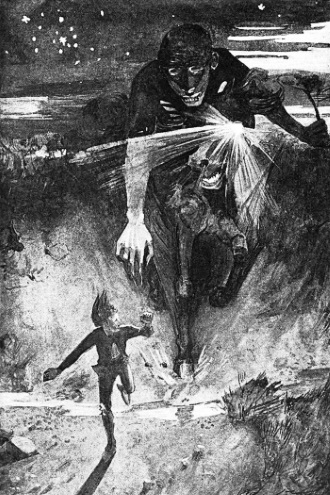
The Ghost of the Missing Edinburgh Piper Boy

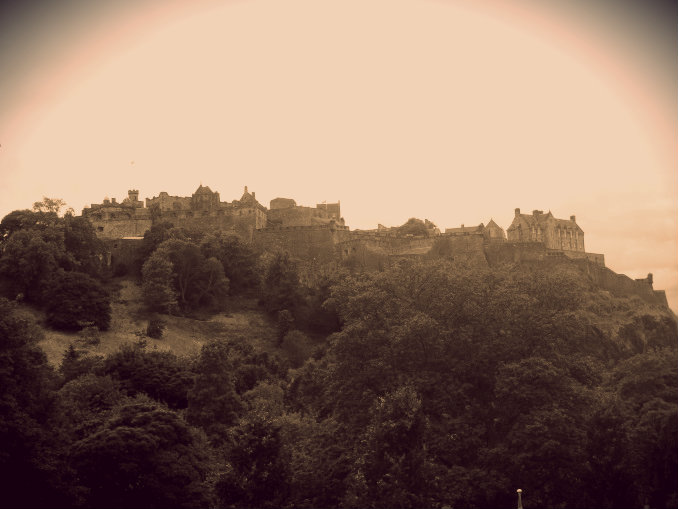
Edinburgh Castle

Edinburgh (Scottish Gaelic: Dùn Èideann) is the capital city of Scotland. It has a rich history and the earliest known human habitation in the area  was at Cramond (Scottish Gaelic: Cathair Amain) a village and suburb in the north-west of Edinburgh. Evidence of a Mesolithic camp site was found here dating to c. 8500 BC. Traces of later Bronze Age and Iron Age settlements have been found in other parts within and surrounding Edinburgh. Amongst the many historic sites that can be seen today is the famous Edinburgh Castle. It stands on the extinct volcano of Castle Rock. Evidence of human occupation on the rock dates back to the Iron Age and there has been a royal castle on the rock since at least the 12th century under the reign of David I of Scotland in the 12th century.

Sgáthach the legendary Scottish warrior queen

Scottish warrior

In Gaelic legend, Sgáthach, or Scáthach, is a Scottish warrior. She features in the Ulster Cycle (Irish: an Rúraíocht) one of the four cycles in Irish mythology along with the Mythological Cycle, Fenian Cycle and the Historical Cycle (also known as the Cycles of the Kings). Sgáthach was said to be a warrior queen whose fortress, Dún Scáith or Dùn Sgàthaich (Fortress of Shadows) is named after her and is on the Isle of Skye (Scottish Gaelic: An t-Eilean Sgitheanach). The remains of  Dunscaith Castle now stand on the site where her fortress was once said to be located.

Sgáthach trained the legendary Irish hero Cú Chulainn, who also appears in Scottish and Manx folklore. He is said to be the son of Lugh, a god in Irish mythology and member of the pre-Christian Gaelic pantheon the Tuatha Dé Danann. In the Ulster Cycle, Lugh fathered Cú Chulainn with the mortal maiden Deichtine who was the sister of Conchobar mac Nessa the king of Ulster. The instruction of Cú Chulainn by Sgáthach is described  in Tochmarc Emire (The Wooing of Emer), one of the stories in the Ulster Cycle. Cú Chulainn had fallen in love with Emer, daughter of Forgall Monach, who opposed to the match. He suggested that Cú Chulainn should complete his training as a warrior with Sqáthach in the land of Alba (Scotland) before marrying Emer. Forgall’s expectation was that Cú Chulainn would be killed in the process.

Scottish Legend Of The Blue Men Of Minch

The minch

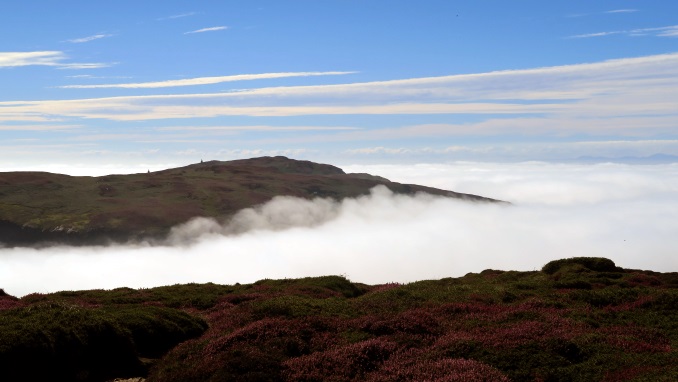
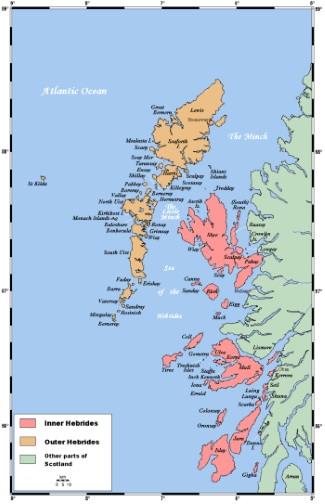
The Outer Hebrides, also known as the Western Isles (Scottish Gaelic: Na h-Eileanan Siar) is an island chain made up of 200 islands in a 130 mile archipelago off the north west coast of mainland Scotland. They form part of the Hebrides, separated from the Scottish mainland and from the Inner Hebrides by the waters of the Minch, the Little Minch and the Sea of the Hebrides. The Minch (Scottish Gaelic: An Cuan Sgitheanach, An Cuan Sgìth, Cuan na Hearadh, An Cuan Leòdhasach), also called North Minch. The Lower Minch (an Cuan Canach), also known as the Little Minch, is the Minch's southern extension.

Legend also tells that the Minch is home to a clan of mythical blue men. Most of the time “The Blue Men Of Minch” swim the seas, but sometimes sleep in underwater caves. While the Blue Men slept the weather could be fine and the seas calm. However, when awake they could conjure up storms whenever they wanted. These creatures, that are the size and shape of humans, are very strong and can be seen swimming and diving with pleasure when the seas are rough. Following the boats that are navigating the waters of the area they can be friendly towards humans, but this can be dependant upon their mood and if they are treated with respect.

Beauty and the Beast - The Legend of the Loch Ness Monster and Beautiful Loch Ness

Loch Ness

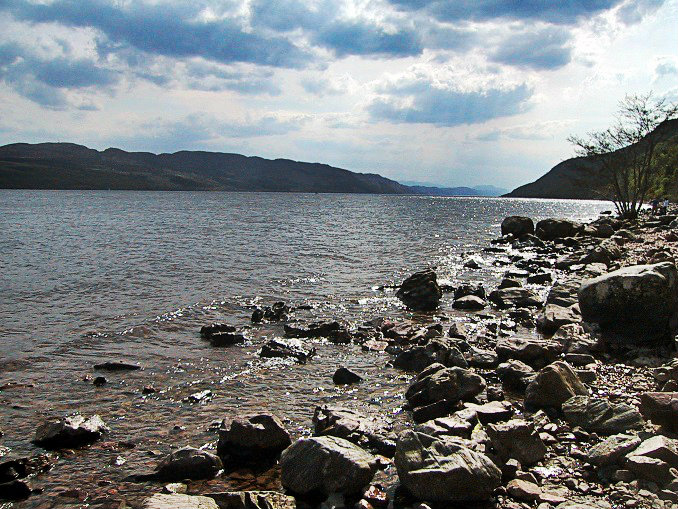
Loch Ness (Scottish Gaelic: Loch Nis) is a freshwater loch in the Scottish Highlands (Scottish Gaelic: A' Ghàidhealtachd). Renowned for its great beauty the Loch is a maximum of  twenty two and a half miles (36.2km) long with a maximum width of just over one and a half miles (2.7km).

The rivers Tarff, Coiltie, Moriston, Farigaig, Enrich, Foyers and Oich along with a number of burns flow into the loch which at its deepest is over 754 feet (230m). It holds about 16 million 430 thousand gallons of water and has just one outlet, the River Ness (Scottish Gaelic: Abhainn Nis), which flows down through the city of Inverness (Scottish Gaelic: Inbhir Nis) in the northeast of Scotland and out into the Moray Firth which is an inlet of the North Sea.

The Mystery of Scotland’s Flannan Isles Lighthouse

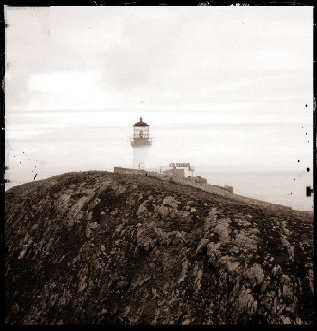
Lighthouse on Eilean Mor, Flannan Isles

Na h-Eileanan Flannach is the Scottish Gaelic name of the small group of islands known in English as the Flannan Isles, located in Scotland’s Outer Hebrides (Na h-Eileanan Siar). Also known as the Seven Hunters they stand just over 20 miles (32 kilometres) from the Isle of Lewis (Leòdhas ). They are a bird sanctuary and at times a place of beauty. At others these remote islands bear the brunt of severe Atlantic storms, which whip the seas into frenzy and force even the hardy gulls to stay sheltered in the cliff face crags. For many years they have remained uninhabited, the last residents of any length being the lighthouse keepers, who between 1899 and its automation in 1971, kept the light burning on the highest point of the island group, Eilean Mòr.

Until the lighthouse had been built between 1895 and 1899 it is probable that Na h-Eileanan Flannach had not been inhabited permanently since the days of the Celtic Church. The Celtic Church was predominant across the Celtic speaking world in the early middle ages (5th to the 10th century). On the island of Eilean Mòr is the ruin of an old chapel dedicated to St Flannan. However, over many centuries for many of the Gaelic Hebridean community the islands have been viewed as a place of superstition and bad luck. A view that was reinforced by the tragic and mysterious events that befell the lighthouse keepers on Eilean Mòr in mid-December 1900.

It is the fate of the lighthouse keepers in 1900; just over one year after the island’s lighthouse came into operation that is the cause of much mystery and speculation. For all three keepers, Thomas Marshall, James Ducat and Donald Macarthur disappeared without trace. It was on 15th December 1900 that the ship Archtor which was sailing for Scotland from Philadelphia had reported that as they passed the islands the lighthouse was not in operation. In those days there was no radio communication between the keepers on Eilean Mòr  and the shore station of Breasclete on Lewis. When the lighthouse tender Hesperus arrived on St Stephen’s Day (26th December) 1900 having been delayed due to adverse conditions, they found the lighthouse abandoned.

Selkie

SelkieThe Selkie-folk, in the mythology of Orkney and Shetland, are a supernatural race of shape-shifting seal creatures.  They are said to be able to shed their seal skin and then take human form. However, it was vital for the Selkie never to lose its seal skin for it was that which gave them the ability to return to their original seal from. Sometimes the Selkies were known for shedding their skins and sunbathing on the beaches and rocks in their human form.
Selkie males were said to be able to turn into handsome mortals and are noted for their encounters with the women they were able to seduce. Selkie females are also said to be highly attractive in their human form to men. In the tale of ‘The Goodman o’ Wastness’ a handsome young man finds a group of Selkie-folk lying naked on the rocks in the sunshine. He surprises them and all but one manages to retrieve their seal skins and escape to the water. In her haste one of the Selkie-folk leaves her skin on the rock and is not able to return to seal form. The Goodman takes the skin.

Kelpie (Mythical 'Water Horse' in Folklore of Scotland)

A Kelpie in the Celtic mythology of Scotland was originally a name given to a ‘Water Horse’. This supernatural entity could be found in the lochs and rivers of Scotland and also has a place in Irish folklore. The description of their appearance can vary in different tales. Sometimes white with smooth cold skin, or black and grey. Some of these variations and the stories associated with the Kelpie are regional in origin.

In some stories they are described as ‘shape shifters’. They are able to transfer themselves into beautiful women who can lure men and trap them. However, the Kelpie does not always take a female form and are mostly male. They are also described as posing a particular danger to children when in the shape of a horse. Attracting their victims to ride them they are taken under the water and then eaten.


In Orkney a similar creature exits known the “Nuggle”. Again this creature takes the form of a horse and waits by the waterside. Any human mounting the horse is taken into the river or loch and drowned. In the Shetland Islands the water horse is known as “Shoopiltie” and again lures people to ride but then plunges into water with its doomed human cargo.

Pages

Subscribe to Celtic Myth & legend