Celtic Myth & legend

‘Fairy Well’ and and the Captured Scottish Piper

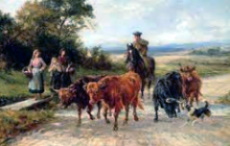
The handsome drover, 1904–1904 painting by Heywood Hardy ((25 November 1842 – 20 January 1933)

In local folklore throughout the Celtic lands there are many stories of the little people, wee folk or fairies. They are often associated with particular locations and there are many 'fairy hills', 'fairy mounds', 'fairy glens', 'fairy wells' and 'fairy bridges'. One such place is the Fairy Well in the Parish of Logie. It is sometimes known as the Highlander’s Well and located not far from the base of Dumyat (Scottish Gaelic: Dùn Mhèad) which is a hill at the western end of the Ochil Hills (Scottish Gaelic: Monadh Ochail) in central Scotland.

Highland drovers would sometimes stop here to allow their cattle to drink on the way to market. Local folklore has it that one of the wee folk (fairy) called Blue Jacket used to guard the well. One summer's day a Highland drover and piper from the Braes of Rannoch came to the Fairy Well with his Highland cattle. He fell asleep beside the Well only to be awoken shortly after by Blue Jacket. The fairy asked where he had come from and the drover told him Rannoch Moor. Blue Jacket then informed him that he was the guardian of the spring he had drunk from.

Scottish Island of Fraoch Eilean Legendary Place of the Death of a Celtic Hero

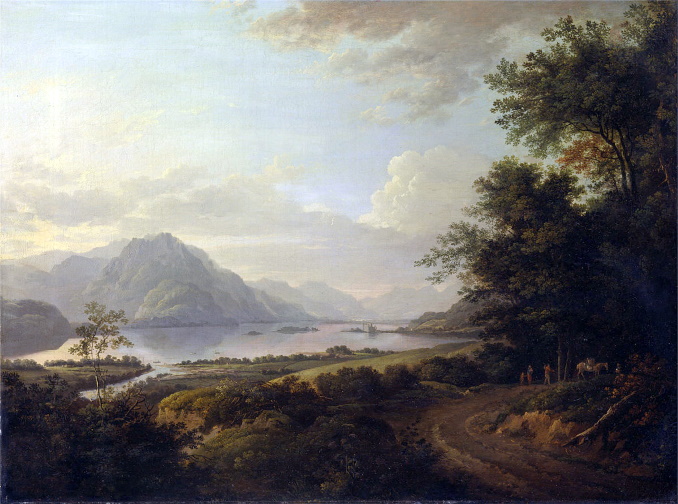
Loch Awe painting by Alexander Nasmyth (1758 - 1840)

Fraoch Eilean is a small island at the northern end of Loch Awe (Scottish Gaelic: Loch Obha), a freshwater loch in the Scottish Highlands (Scottish Gaelic: a’ Ghàidhealtachd). It is one of a number of islands within the loch. The island of Fraoch Eilean has a particular legend attached to it and has a name that links it with an ancient Celtic hero known as Fraoch or Fráech.

He appears in the Ulster Cycle of Irish mythology. The Ulster Cycle (Irish: an Rúraíocht) is  one of the four great cycles of Irish mythology and is a body of medieval Irish heroic legends and sagas. It is thought the stories take place around or before the 1st century AD.

Fairy Folk Of The Cairngorms

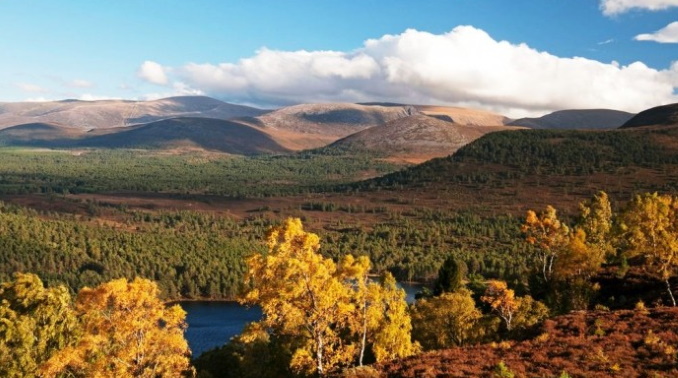
Rothiemurchus forest Loch-an-Eilein and Cairngorms from Ord-Ban-Hill. Courtesy of Cairngorms National Park website.

Cairngorms National Park (Scottish Gaelic: Pàirc Nàiseanta a' Mhonaidh Ruaidh) is a national park in northeast Scotland and covers the Cairngorms range of mountains, and surrounding hills. It is an area of outstanding natural beauty with mountains, forest paths, rivers, lochs and locations known for their abundance of wildlife. It is also, along with the rest of Scotland and indeed other parts of the Celtic world, rich in folklore.

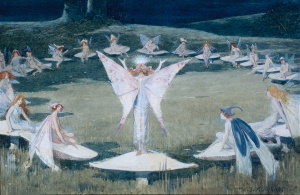
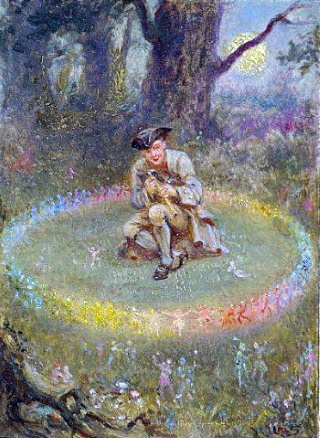
 ‘A Fairy Ring’ by Walter Jenks Morgan, RBA, RBSA (1847-1924).

Celts had and continue to hold a great respect for the environment. Reflected in the folklore and mythology often attached to particular geographic locations. Celtic beliefs perceived the presence of the supernatural in every mountain, river, coastal feature, spring, loch, marsh, tree and rock formation. Within this tradition there is a strong link to animism and shapeshifting in Celtic mythology. There are also many stories about the little people and fairies. A belief, still widely held in some places, that humans and other creatures share their land with mystical non-human entities, rarely seen, but through custom treated with caution and respect. Not least because the little people are not always viewed as benevolent and can be quite sinister and dangerous.

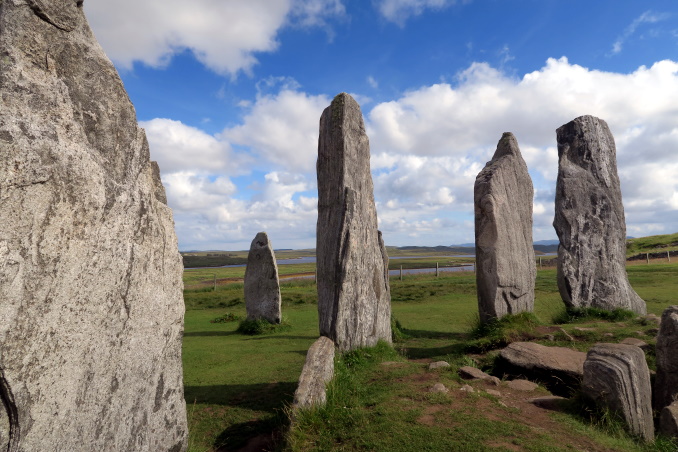
Mystery of Scotland's Ancient Callanish Standing Stones

Clannish standing stones

All around the Celtic world there are many cairns, stone circles, standing stones and carvings in rock dating from prehistory before the time of written records. Ancient stones and tombs placed in a way that look to the stars and capture moments of astronomical importance. The rising and setting of the sun and moon during the summer and winter equinoxes. According to archaeologists the ancient Irish were the first to record a solar eclipse 5,354 years ago. A geometric etching illustrating the eclipse is thought to lie inside the Cairn L. This is one of the two large focal monuments on Cairnbane West outside Kells in Ireland’s County Meath. The carving of concentric circles and lines is at the back of the chamber of the cairn.

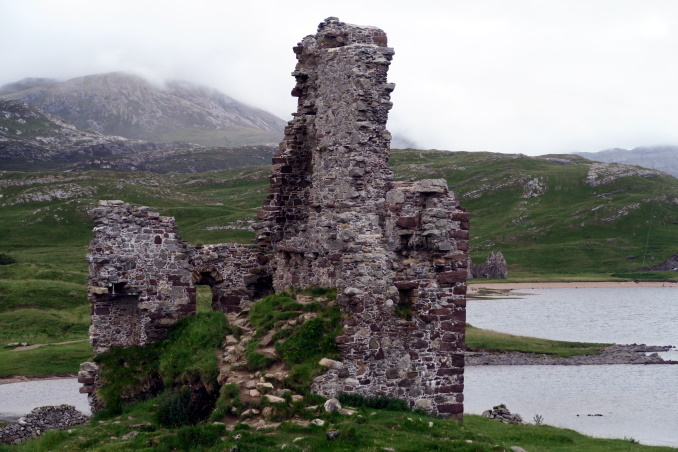
Weeping ghost of Ardvreck Castle, Loch Assynt, once betrothed to the Devil

Ardvreck Castle

There is an air of mystery about Loch Assynt (Scottish Gaelic: Loch Asaint) in Sutherland, Scotland. A freshwater loch, it lies in a spectacularly beautiful setting surrounded by the mountains in the area of Assynt. Noted for its wonderful landscape its has, along with neighbouring Coigach, been designated as the Assynt-Coigach National Scenic Area (NSA). NSA's are areas in Scotland identified for their exceptional scenery with a conservation designation that protects them from inappropriate development. Loch Assynt is beautiful and takes its mood from the many changes in weather conditions that take place in this part of Scotland. Sometimes the water is still, calm and like a mirror, reflecting the magnificent surrounding snow capped mountains. At times the waters are whipped up by the winds that sweep down the hillsides. At its most mysterious it is shrouded by a mist that swirls over the flat surface of the Loch. Where every sound; some that can be identified and others that can't, echo around the water's edge. It is the type of setting that is ripe for stimulating the imagination.

Robert Kirk "The Fairy Minister"

Man surrounded by fairy folk

Aberfoyle (Scottish Gaelic: Obar Phuill) is a village that lies inside the Lomond & Trossachs National Park (Scottish Gaelic: Pàirc Nàiseanta Loch Laomainn is nan Tròisichean). Seen as a gateway to the Trossachs, Aberfoyle is situated on the River Forth (Abhainn Dubh) at the foot of Craigmore. Loch Ard (Loch na h-Àirde) , Loch Chon, Loch Arklet and Loch Lomond (Loch Laomainnare) to the West, Loch Katrine (Loch Ceiteirein), Loch Achray and Loch Venachar (Loch Bheannchair) to the North and the Lake of Menteith (Loch Innis Mo Cholmaig), to the East. The village is an attractive place to visit with a number of connections to historical figures. One of the most famous being the Reverend Robert Kirk, 

Robert Kirk (9 December 1644 – 14 May 1692) was a minister, Gaelic scholar and folklorist. He was the seventh son of the minister of Aberfoyle. He went on to study theology and eventually became minister of Aberfoyle, from 1685 until his death in 1692. He is noted for providing the first translation to Gaelic of the book of Psalms, published at Edinburgh in 1684 as Psalma Dhaibhidh an Meadrachd, &c. He also helped in one of the first publications of the bible into Scottish Gaelic. However, it was for another work, The Secret Commonwealth, and the stories that surround his death that he is now best remembered. Robert Kirk had an interest in the supernatural, fairies, folk beliefs, second sight and traditional stories and beliefs held by the people of the Scottish Highlands. He collected and wrote about these tales in around 1691, although his work was not published in his lifetime. They were released by Scottish author Walter Scott in 1815, then later a second edition was published in 1893, under the title The Secret Commonwealth of Elves, Fauns and Fairies.

Halloween Poem by Scotland’s Robert Burns

Halloween in Scotland has its roots in Celtic pagan tradition. This old Celtic New Year celebration of Samhuinn (Scottish Gaelic) starts on the eve of 31st October when witches, fairies  and the spirits of the dead roam the countryside. The poem below was written by Scotland’s national poet Robert Burns (25 January 1759-21 July 1796)

Upon that night, when fairies light
On Cassilis Downans dance,
Or owre the lays, in splendid blaze,
On sprightly coursers prance;
Or for Colean the route is ta'en,
Beneath the moon's pale beams;
There, up the cove, to stray and rove,
Among the rocks and streams
To sport that night.

Mysterious Halloween in Ballantrae - A Scottish ghost story

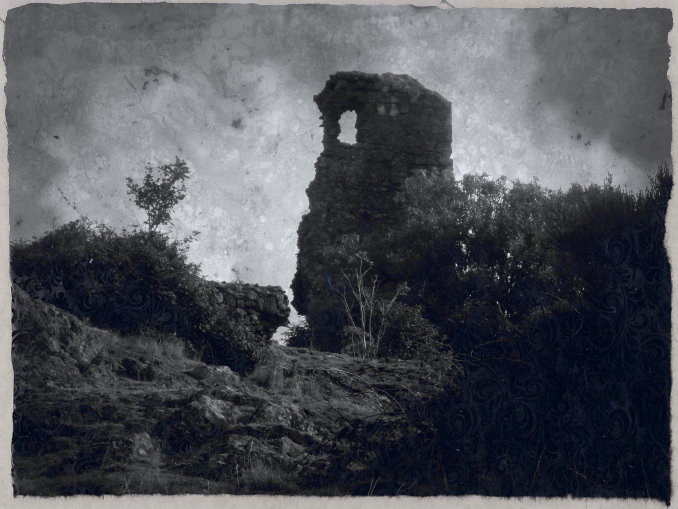
Ardstinchar Castle

Ballantrae (Scottish Gaelic: Baile na Tràgha) is a village on the south-west coast of Scotland. It is in South Ayrshire (Scottish Gaelic: Siorrachd Inbhir Àir a Deas). Ballantrae is famous as the setting for the novel The Master of Ballantrae by Robert Louis Stevenson published in 1889. In the distance can be seen the magnificent uninhabited island of Ailsa Craig. Formed from volcanic remains it is some ten miles from the Scottish coast and rises to a height of 1,110 feet (338m).

As Robbie walked from his home in the village he looked out across the sea towards the Ailsa Craig, but the mist had shrouded the small island. It felt strange not to see it looming in the distance so dominant is it on this part of the Scottish coastline. Robbie had finished work early today the 31st October. He had arranged to meet up with some friends in the evening to celebrate the night of Halloween. However, with time on his hands until then, he decided to use this opportunity to take some exercise and wander around the many paths that made this area such a ramblers paradise. Ballantrae is sometimes referred to as the gateway to Carrick. Carrick is a name derived from the Scottish Gaelic word Carraig meaning rock or rocky place. It is a district that was part of the old Kingdom of Galloway. This Kingdom is associated with the same Norse-Gael world of Isle of Man, Hebrides and Dublin. These old Norse colonies and the Vikings that had settled there had been subject to Gaelicisation. They had integrated into Gaelic society and adopted the language and customs of the Gaelic people who lived in these lands.

The Fairy Flag And The Chiefs Of Clan MacLeod

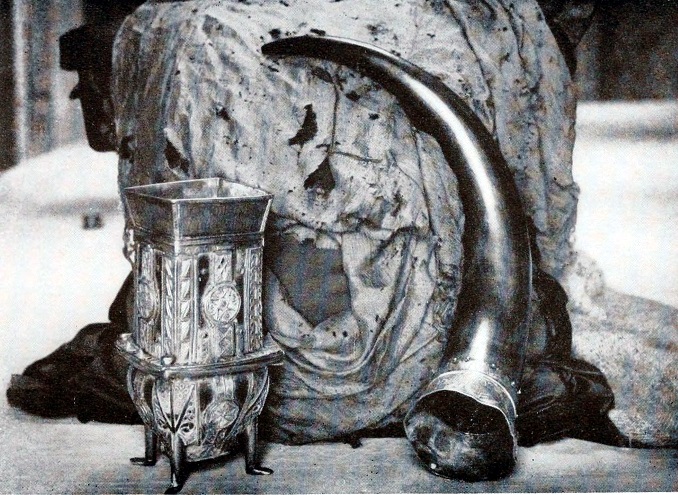
Fairy flag

The Fairy Flag (Am Bratach Sìth) is a flag which is said to have magical properties; it belongs to the chiefs of the Clan MacLeod. It is located in Dunvegan Castle, which is close to the town of Dunvegan (Dùn Bheagain) on the Isle of Skye in the Inner Hebrides of Scotland. The fragile silk flag is about 18 inches squared. The origins of the flag are not clear and there are a number of legends which say that the flag was a gift from the fairies.

One such story was that a young chief of the Clan MacLeod fell in love with a fairy princess and proposed marriage. The King of the Fairies initially forbade his daughter’s betrothal to a mortal, but relented on seeing her distress. However, he stipulated that the marriage should last no more than a year and one day, at which time she should return to the Fairy Kingdom with no human possessions. The couple were much in love and had a son. On the day that the marriage was ordered to end the sad couple were rendered apart. One version of the story is that she presented her husband with the fairy flag for protection at the nearby “Fairy Bridge” from where she re-entered the Fairy Kingdom. Another version is that the fairy princess told her husband to look after their son well and not to let him cry as she would hear and it would break her heart.

Legend of Sawney Bean the Scottish cannibal

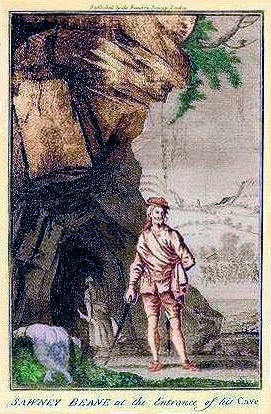
Alexander Sawney Bean

Sawney Bean was said to have been the head of a criminal, cannibalistic family in 15th century Scotland. Legend has it that he, his wife and 46 children and grandchildren killed and ate over a thousand people before they were captured and executed. Alexander  Bean was born in East Lothian (Scottish Gaelic: Lodainn an Ear) during the 1500s. After he married the couple went to live in a coastal cave in Bennane Head at the northern end of Ballantrae Bay, 11 miles (17 km) southwest of Girvan in South Ayreshire (Scottish Gaelic: Siorrachd Inbhir Àir a Deas).

They and their family lived in the deep hidden cave, the entrance of which was blocked by water during high tides, for twenty-five years. During that time they were said to have been responsible for the murder and cannibalisation of over 1,000 people. At night time the family would go out hunting for individuals of groups of people. They would ambush, rob and murder them, then bring their bodies back to the cave, where they were dismembered and eaten. The leftovers were pickled to provide food another day. Although the discarded body parts would sometimes wash up on nearby beaches and the mysterious disappearance of people was of great concern to local people, the existence of the clandestine clan remained unknown.

Pages

Subscribe to Celtic Myth & legend